

$1.2m ARC funding to boost national X-ray spectroscopy capability through Swinburne and QUT partnership

Swinburne's XAS facilities team will be led by Associate Professor Rosalie Hocking, and include Professor Feng Wang and Associate Professor Andrew Ang
In summary
- Swinburne has secured $1.2 million in the latest Australian Research Council Linkage Infrastructure, Equipment and Facilities scheme round
- The funding will support the creation of state-of-the-art laboratory-based X-ray Absorption Spectroscopy (XAS) facilities, delivered through a collaborative consortium led by Swinburne
- These new XAS laboratories will offer researchers faster instrument access and the ability to carry out long-term studies
Swinburne University of Technology researchers have secured over $1.2 million in the Australian Research Council (ARC) Linkage Infrastructure, Equipment and Facilities (LIEF) 2026 Round 1 to establish new laboratory-based X-ray Absorption Spectroscopy (XAS) facilities in Victoria and Queensland.
Led by Associate Professor Rosalie Hocking, the project brings together an interdisciplinary team including Swinburne’s Professor Feng Wang and Associate Professor Andrew Ang.
Swinburne’s Deputy Vice Chancellor, Research, Professor Karen Hapgood, said she is proud Swinburne is leading research that addresses real world challenges.
“By establishing these laboratory-based XAS facilities in Victoria and Queensland, we’re giving researchers across Australia faster, easier access to a critical tool for materials analysis,” Professor Hapgood said.
“This will speed up experiments and allow long-term studies under real-world conditions, driving innovation across energy, environmental and sustainability research. This successful project represents key research strengths within Swinburne’s research ecosystem, encompassing our longstanding expertise in chemistry materials science and engineering.”
The funding will support the creation of two mirrored XAS laboratories, one at Swinburne and another at Queensland University of Technology. Together, the facilities will significantly expand Australia’s access to a vital materials characterisation technique traditionally limited by restricted availability at large-scale synchrotron sources.
A synchrotron is a type of particle accelerator that produces extremely bright beams of light, including X-ray light. Scientists use these X-rays to study the structure and properties of materials in very high detail, from minerals and metals, to biological samples and advanced materials. Synchrotrons are expensive to build and operate, and access is extremely competitive.
“To tackle modern challenges like clean energy and advanced manufacturing, we need to deeply understand materials,” says Associate Professor Rosalie Hocking.
“Just as understanding the structure of DNA transformed biology, by getting the right tools to study materials, we will unlock the next wave of innovation. X-ray Absorption Spectroscopy helps us see how materials behave at an atomic level.
“It is key for a diverse range of scientific endeavors, from designing new energy technologies like electrolysers and batteries, to improving recyclability and securing critical mineral supply chains. Building two new lab-based facilities in Victoria and Queensland will expand access to this critical analytical tool.”
By enabling rapid access and long-term studies, the new laboratory-based XAS capability will accelerate research across key national priority areas including electrocatalysis, environmental science, critical minerals and the circular economy. Shared management, data handling and cross-institution collaboration will ensure the facilities operate as a unified national resource.
The project is expected to drive innovation, strengthen research partnerships and enhance Australia’s global competitiveness in advanced materials and sustainability research.
-
Media Enquiries
Related articles
-

- Student News
- Science
- Sustainability
Introducing tomorrow’s global science communicators
Start Talking is Swinburne’s unique video-based public speaking competition, exclusively for undergraduate students
Monday 08 December 2025 -
- Astronomy
- Technology
- Health
- Science
- University
- Sustainability
- Engineering
Swinburne highly cited researchers reach the top in 12 fields
Ten Swinburne academics have been named on the Highly Cited Researchers 2025 list, released by Clarivate
Tuesday 02 December 2025 -
- Science
- Engineering
Swinburne secures grant to advance next-generation metamaterials research
Swinburne physicist Dr Weibai Li has received a Discovery Early Career Researcher Award from the Australian Research Council
Tuesday 02 December 2025 -
- University
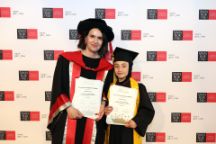
Over 550 students don caps and gowns to graduate from Children’s University Swinburne
Over 550 students from 34 schools have graduated from Children’s University Swinburne, celebrating over 45,000 hours of learning beyond the classroom this year.
Wednesday 03 December 2025 -

- Technology
- Health
- Science
- University
$1.2m ARC funding to boost national X-ray spectroscopy capability through Swinburne and QUT partnership
Swinburne has secured $1.2 million in the latest Australian Research Council Linkage Infrastructure, Equipment and Facilities scheme round
Tuesday 02 December 2025


