

Swinburne’s new academic schools structure designed to power Horizon 2025 strategy

Students and academics will benefit from the new academic school structure
In summary
- The new schools structure aligns the university's academic activity around six schools and the new Horizon 2025 strategy.
- Students and academics will benefit from an improved configuring of complementary disciplines.
- Swinburne took an open and collaborative approach to design the new structure for academic advantage and growth.
Swinburne University of Technology’s new schools structure becomes effective today, aligning the university’s academic activity around six schools and the new Horizon 2025 strategy.
“Our new academic structure means that we are more aligned to Swinburne’s strategic purpose of bringing people and technology together to build a better world,” Professor Chris Pilgrim, Deputy Vice-Chancellor (Academic) – Interim, said.
“Students and academics alike will benefit from this improved configuring of complementary disciplines to achieve academic advantage and growth,” he said.
Swinburne’s six higher education schools are now:
- School of Business, Law and Entrepreneurship, led by Professor Keryn Chalmers
- School of Design and Architecture, led by Professor Jane Burry
- School of Engineering, led by Professor Emad Gad
- School of Social Sciences, Media, Film and Education, led by Professor Mia Lindgren
- School of Health Sciences, led by Professor Bruce Thompson
- School of Science, Computing and Engineering Technologies, led by Professor Alex Stojcevski
Professor Mirko Bagaric will continue to lead the Swinburne Law School, which now becomes part of the School of Business, Law and Entrepreneurship.
As previously announced, Professor Virginia Kilborn will officially step into her new role as the inaugural Swinburne Chief Scientist.
“Swinburne’s open and collaborative approach to this design ensures that we are focused on delivering what’s best for our students and providing an environment for them to thrive,” Professor Pilgrim said.
“We are committed to providing opportunities for our students, such as work integrated learning, that will ensure that the university experience is an enriching one and offers real world opportunities.
“Current and new students can feel confident that Swinburne’s schools and courses will be the best available to help them build their new career, now,” he said.
-
Media Enquiries
Related articles
-

- Astronomy
- Technology
- Health
- Science
- University
- Sustainability
- Engineering
Swinburne highly cited researchers reach the top in 12 fields
Ten Swinburne academics have been named on the Highly Cited Researchers 2025 list, released by Clarivate
Tuesday 02 December 2025 -
- University
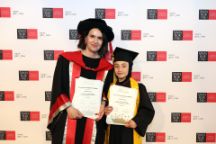
Over 550 students don caps and gowns to graduate from Children’s University Swinburne
Over 550 students from 34 schools have graduated from Children’s University Swinburne, celebrating over 45,000 hours of learning beyond the classroom this year.
Wednesday 03 December 2025 -

- Technology
- Health
- Science
- University
$1.2m ARC funding to boost national X-ray spectroscopy capability through Swinburne and QUT partnership
Swinburne has secured $1.2 million in the latest Australian Research Council Linkage Infrastructure, Equipment and Facilities scheme round
Tuesday 02 December 2025 -

- University
Swinburne researchers shine at the 2025 Media and External Communications Recognition Awards
Swinburne’s 2025 Media and External Communications Recognition Awards have recognised our academics for notable media and social media outreach.
Thursday 04 December 2025 -
- University
Update on Union Street Windsor
An update from Swinburne University of Technology on the property at 131–133 Union Street, Windsor.
Friday 07 November 2025


