

Swinburne researchers secure funding grant for bioinspired nanomaterials

‘Nanoparticle origami’ or nanoparticle self-assembly can be used in the creation of new materials when stimulated with light or magnetic fields.
In summary
- Swinburne researchers will share in funding for an international project of up to $US8.5 million ($12.6 million).
- Professor Peter Kingshott from the Department of Chemistry and Biotechnology will lead the Swinburne team to explore the creation of completely new, responsive materials.
Researchers from Swinburne University of Technology have received funding for the development of cutting-edge, responsive materials with potential applications in fields ranging from drug delivery to materials science.
Professor Peter Kingshott from the Department of Chemistry and Biotechnology secured the large, multi-institutional grant through the AUSMURI program, a joint initiative of the US Department of Defense and Australia’s Department of Defence.
“This is a unique project that brings together a highly complementary team of experts where the possibilities for major breakthroughs in materials science are enormous”, Professor Kingshott said.
Using ‘nanoparticle origami’ or nanoparticle self-assembly, Professor Kingshott will lead the team responsible for modifying nanoparticles with complex chemistries that can be used in the creation of new materials through self-assembly or ‘DNA origami’ when stimulated with light or magnetic fields.
The work strengthens Swinburne’s position as a global leader in scientific innovation.
“The funding also establishes new research networks, both within Australia and in the US, that will expand our capabilities in the field and create a long-lasting legacy in Australian science”.
The multimillion-dollar funding deal will be shared in Australia between Swinburne and additional collaborators from the University of Sydney and the University of Melbourne.
The US part of the project is led by Colombia University, and further involves Johns Hopkins University, University of Michigan and University of Wisconsin-Madison. Total funding for the project is up to $US8.5 million ($12.6 million).
“This project is an incredibly collaborative effort with partners from the US and Australia who have broad expertise in experimental and computational materials science and nanotechnology.
“We’re confident that bringing together traditionally separated fields and unexplored ideas will result in some truly transformative concepts”, said project lead from Columbia University, Professor Oleg Gang.
“I am excited about the vision of this project to create new-generation responsive materials by combining adaptable, self-assembling biological structures with inorganic nanomaterials”, said Professor Marcela Bilek, the Australian lead, from the University of Sydney.
Other key researchers in Australia include Dr Shelley Wickham and Dr Anna Waterhouse from the University of Sydney and Professor Amanda Ellis from the University of Melbourne.
-
Media Enquiries
Related articles
-
- Technology
- Science
- Sustainability
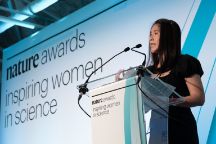
AI innovation protecting biodiversity wins global award for Swinburne researcher
Swinburne Sarawak researcher, Ts Dr Lee Sue Han has won a 2025 Inspiring Women in Science Award for her AI-driven biodiversity research, which uses artificial intelligence to identify plant species, protect ecosystems and support sustainable agriculture.
Friday 06 March 2026 -
- Technology
- Social Affairs
- Health
- Science
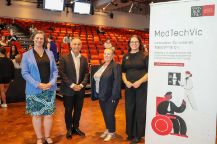
Driving meaningful progress in assisted living tech
Swinburne’s MedTechVic hub annual showcase brings together research, lived experience and practical innovation in assisted living technologies. This year's theme was ‘Real innovation, real lives’, highlighting the hub’s ongoing commitment to driving inclusive innovation.
Thursday 12 February 2026 -
- Design
- Technology
- Health
- Law
- Education
- Business
- Science
- University
- Engineering
Swinburne moves up in Times Higher Education World University Rankings by Subject 2026
Swinburne University of Technology has performed strongly in the Times Higher Education World University Rankings by Subject 2026, with two subjects moving up the ranks.
Thursday 22 January 2026 -
- Technology
- Science
- University
- Aviation
- Sustainability
- Engineering
Swinburne secures AEA funding in aerospace, critical metals, sustainable steel production and protective helmet design
Swinburne University of Technology researchers have secured over $1.6 million in funding from Australia’s Economic Accelerator (AEA) Ignite grants.
Thursday 22 January 2026 -

- Student News
- Science
- Sustainability
Introducing tomorrow’s global science communicators
Start Talking is Swinburne’s unique video-based public speaking competition, exclusively for undergraduate students
Monday 08 December 2025


